Monday, November 11, 2013

Are You Throwing Away Money?

A lot of people liked the historical pictures of Central Avenue! I've had a couple of offers of more pictures of both Central Avenue and Minnesota Avenue, so I'll start putting together another "then and now" post. Stay tuned.  :-)

Today, we're going to head south in the District to Armourdale. Last week I had the pleasure of visiting one of the most fascinating businesses in the district, and I'd like to share what I saw / learned.

This is how AMR's most visible building looks from 7th Street.

I don't know about everyone else, but when I hear "metal recycling" I typically only think about the aluminum cans and tin cans that we put in our green recycling containers every Wednesday.

As I learned last week, there is lots and lots more metal that can be recycled...and we can get paid if we put in the effort to recycle it! Huge thanks to Raynard Brown and Brian Jacobs for giving me a tour and educating me about the operation of Advantage Metals Recycling (AMR).

AMR is located at 1015 S. Packard (just east of 7th Street Trafficway and just north of the Kansas River) in the southern part of Armourdale.

The red lines outline Advantage Metals Recycling.
You can see the Kansas River at the bottom of the picture.

This particular location first opened in 1954 and it became AMR in 2008. The company employs 45 people to operate the 15 acre Armourdale site. It's one of 16 different AMR locations in Kansas and Missouri.

Now here's the part that blew my mind… this one location recycles close to 350 million pounds of metal every year!

About 60% of that total comes from businesses. The other 40% comes from people like you and me.

There's lots of aluminum that can be recycled besides soda cans.
Among other things, this bin had the rollers from an old garage door,
the chassis from an electronic device and a discarded TV antenna.
(Click any picture to get a larger look.)

AMR collects both ferrous metals (containing iron) and nonferrous metals (not containing iron) from individuals and businesses in about a 150 mile radius around Kansas City. They sort and process everything they receive, and ship the chopped, shredded, pressed and/or bundled results of their efforts to manufacturing plants within about a 500 mile radius of Kansas City.

Those plants then melt the recycled metal from AMR and reuse it to create new metal products.

For example, back on October 9, demolition crews demolished the steel superstructure of the old Amelia Earhart bridge in Atchison, Kansas. Guess where it all ended up? That's right… Advantage Metals Recycling. The picture below shows pieces of the bridge girders (green in color) waiting to be chopped up and loaded onto train cars.

A stack of metal including girders from the Amelia Earhart bridge
wait to be chopped, shipped and used again.

Here's a quick list of the metal that the company accepts:
  • Steel/iron
  • Cast iron
  • Stainless steel
  • Aluminum
  • Copper
  • Brass
  • Lead
  • Zinc
  • Assorted alloys
All sorts of manufacturers and contractors (like General Motors in Fairfax and Kawasaki in Maryville, Missouri) do their part to keep the environment clean by shipping all of their excess, defective or discarded metal to AMR for recycling.

It doesn't look like much, but this metal "chopper"
is the most impressive equipment in the plant.
Metal gets loaded into the little building by the crane at right.
A giant piston (red arrow) drives two sets of giant blades
that chop the metal up small enough it can be loaded into train cars.

Another crane with a big claw (think "Toy Story")
picks up chunks of chopped metal and loads them in a train car for shipping.

As I walked around the yard, it occurred to me that this isn't anything like the junkyard on the old TV show "Sanford and Son". Although they effectively deal in "junk", AMR is a sophisticated, high-quality, precision operation.

And it's no small challenge to build a recycling plant like this one. For example, each one of the big yellow cranes (seen in several different pictures here) costs over $600,000. The giant "metal chopping" machine contains four blades that cost about $5,000 each. The blades last about a month before they need to be replaced! And those are only two examples of the high tech equipment scattered throughout the site.

This impressive machine uses giant rams to squish
soft metals and wire into bales that are shipped off for reuse.

Two examples of the output from the baler...
aluminum cans (lower left) and random wires (upper right).

Who knew?? This big tangled, white and green mess contains
hundreds of strings of broken Christmas lights that are being recycled.

Boxes of metal pieces wait to be squished and baled for shipping.
The variety of objects that have been recycled is surprising (lower left).

One thing that many people are concerned about is the recycling of stolen metals.

It's no secret that air conditioner coils and copper pipes (among other things) are very often targeted by thieves looking to make a quick buck. Although the amount of money that the thieves might receive from a recycling center is relatively small, they almost always leave behind a large mess and a big repair bill.

I was very impressed with the steps that AMR takes to discourage thieves from attempting to recycle stolen metal at their site.

They have a clear and comprehensive set of guidelines governing what kinds of metals can to be recycled and by whom. Additionally, they keep accurate records of every recycling transaction.

For example, every consumer transaction is recorded in multiple ways. Cameras and scanners located throughout the plant capture images of the person who is doing the recycling, his or her driver's license, his or her vehicle and the metal that is being recycled. Additionally, the person who is doing the recycling is not handed cash at the checkout counter. Instead, they are given a card that can be inserted into an ATM located outside the building.

A sign in the consumer recycling area details the restrictions
on what can be recycled and by whom.

Mr. Brown said that AMR has made a tremendous investment in video and computer technology to support the anti-theft efforts. The company stores terabytes (lots and lots) of data each year on their computer servers. He said that AMR provides information to local police departments five or six times a month to help in the investigation and/or prosecution of theft cases.

Additionally, AMR has been an active participant in helping all KC area governments create and update ordinances that regulate the recycling process and make it harder for thieves to profit.

All those gray strips at the bottom of this pile are
lawn mower blades that didn't make the cut (so to speak)
and are being recycled.

The gigantic pile of metal shavings behind the blue container
is what's left after the Kawasaki plant in Maryville, Missouri
mills aluminum blocks to make motorcycle engines.

Although it looks like a giant pile of red hair, this huge tangle
is composed of the steel cords that go into "steel-belted" tires.
It's brown instead of silver because the cords have oxidized from sitting outside.

An AMR employee (right foreground) waits for a crane
to come unload a customer's trailer (left foreground).
The size of the pile behind the employee gives you
a sense of the volume of metal processed by AMR.

So... the next time you're about to throw some metal in the trashcan, consider taking it to Advantage Metals Recycling. They are open Monday - Friday from 8:00am to 4:30pm and on Saturday from 8:00am to noon.


Have a great week!
~ Brian

bmckiernan@wycokck.org
- or -
Suggestion Box


Monday, November 4, 2013

Central Avenue - Then and Now (in Pictures)

The other day, I stopped by the office of the Central Area Betterment Association to talk with Marty Thoennes and I noticed that he had several old photographs of Central Avenue hanging on the wall.

I had a great time looking at those old photographs and mentally comparing them to how Central Avenue looks today. I thought you might also enjoy a look at Central Avenue "then and now".

Marty had 12 prints that were not in frames and he loaned them to me for the afternoon. I had the prints scanned into digital pictures and I've posted them here.

The photos are arranged from east to west. The caption for each photo gives the rough description of the vantage point and what the photo shows.

Last Friday afternoon, I went out and took "now" photos... trying to get as close to the original vantage point as I could (without getting run over!). I cropped my new photos so that they showed a view that is as close to the old photo as possible.

I hope you enjoy the look back as much as I did. The photos show up fairly small in the blog, but the originals that I uploaded are really big, so if you click on one picture, you'll be able to view them all in a much larger size.

The first photo is dated August 11, 1945, so I assume that all of the photos were taken sometime in the mid 1940s.

I'm sure you'll all see different details, but here are a few things that stood out to me:

  • There was diagonal parking along Central Avenue in all of the old photos, BUT there was no "center turn lane". Looks like we had to trade one for the other.
  • There are lots and lots of overhead wires in the old photos.
  • There are streetcar (trolley) tracks and/or streetcars (trolleys) in every photo. So... we used to have "light rail", then we tore it out and now were thinking about putting it back. :-)
  • There were very few gaps between buildings in the old photos. Central Avenue "today" has what I call "hillbilly teeth" (i.e., one building... a lot of empty space... another building... etc.) compared to Central Avenue "then".
  • There are tons of people and cars in almost every photo.
  • The old streetlights looked cool.

Enjoy!

= = = = = = = = = = = = = = =

Looking east towards 7th Street while standing at Simpson Avenue.

Not nearly as many buildings in this view.
= = = = = = = = = = = = = = =

Still looking east towards 7th Street, but a little further around the bend.

Almost none of the buildings on the north (left) side of the street still exist.
= = = = = = = = = = = = = = =

Looking west toward 10th Street from about Ferree Street.

All of the old buildings east of 10th (close to the camera) are gone.
= = = = = = = = = = = = = = =

Looking southeast while standing at the corner of 10th and Central.

There used to be a building on the triangle
that is now Lally Park (tall evergreen)!!
= = = = = = = = = = = = = = =

Looking east toward 10th and Central from about Baltimore St.

Look at all the old buildings that are "missing" on the left side of the street.
(I still remember what it smelled like the night Drew Hardware burned.)
= = = = = = = = = = = = = = =

Looking east from between 16th and 17th Streets.

A pretty comparable view.
= = = = = = = = = = = = = = =

Looking west to the intersection of Central Avenue, 18th Street and Park Drive.

Wow! All the buildings on the right side of Central are now gone.
Also gone is the Standard Service station and the house
on what is now Trolley Park (middle of photo).
= = = = = = = = = = = = = =

On the other side of the intersection...
Looking east at the intersection of Central Avenue, 18th Street and Park Drive.

This photo is from street level since there's no
wall behind the Standard Service station to climb on.
= = = = = = = = = = = = = = =

Looking southeast at 19th Street and Central Avenue.
That's a house up on the hill among the trees.
Off to the right you can see "Kroger's" on the building
that has most recently been Casa de Tacos and Casa de Hernandez.

It's amazing to me that we took away the gas station, house and all the dirt
in the little triangle that is now Trolley Park.
= = = = = = = = = = = = = = =

Looking southwest along Park Drive from 21st Street.


= = = = = = = = = = = = = = =

Looking "back" northeast along Park Drive from about 22nd Street.

The road is in much better shape without the trolley tracks.
= = = = = = = = = = = = = = =

Looking west along Park Drive between 22nd and 23rd Streets.


= = = = = = = = = = = = = = =

Click a link below to send me a message if you have any thoughts or observations.

If anyone has any old / historical photos of Minnesota Avenue or Kansas Avenue, please drop me a note. I'd love to scan those photos to digital pictures and do a "then and now" look at those avenues as well.

Have a great week!

~ Brian

bmckiernan@wycokck.org
- or -
Suggestion Box


Thursday, October 31, 2013

Lots of Moving Parts in KCK Bus Transportation


Earlier this month, Mayor Holland asked me to represent the Unified Government on the Regional Transit Coordinating Council (RTCC). This council is chaired by representatives of the Mid-America Regional Council (MARC) and the Kansas City Area Transportation Authority (KCATA) and includes representatives from all of the cities and counties in the metro area who are working to create a uniform approach to public transportation throughout the area.

New transit centers at 7th & Minnesota and 47th & State
are among the many reasons that ridership is skyrocketing
on the State Avenue Connex bus route.

I've begun doing my homework to educate myself on the scope of the system around Kansas City and I have discovered that there are a ton of moving parts (pun intended) associated with public transportation in the metropolitan area.

Today, I'll share some of what I've learned about the challenges of providing efficient and effective bus transportation. Although we love our cars in the Midwest, many people depend on busses for transportation and many others are making the choice to park their automobiles and take advantage of public transportation like busses.

First, let's look at the metropolitan area as a whole. There are four agencies / governments that provide bus service: 1) KCATA; 2) Wyandotte County; 3) Johnson County: and 4) the city of Independence, Missouri). KCATA is the umbrella organization that is set up to serve the entire metropolitan area.

Here's a map of all "fixed route" bus service in Wyandotte County.
The UG and KCATA team up to service these routes.
I left the image big so you can click on it and see a bigger version,
I've also included a picture of each individual bus route below.

According to Wikipedia, "The Kansas City Area Transportation Authority (KCATA) is a public transit agency in metropolitan Kansas City. It operates the Metro Area Express (MAX) bus rapid transit service in Kansas City, Missouri, and 69 local bus routes in seven counties of Missouri and Kansas.

Although KCATA was formed in the mid 1960's by an interstate compact and an act of Congress, it was not given any taxing authority (i.e., the ability to raise its own money). Since only about 15% of its $83 million budget comes from operating revenues, most of the rest comes from payments made by the cities and counties it serves.

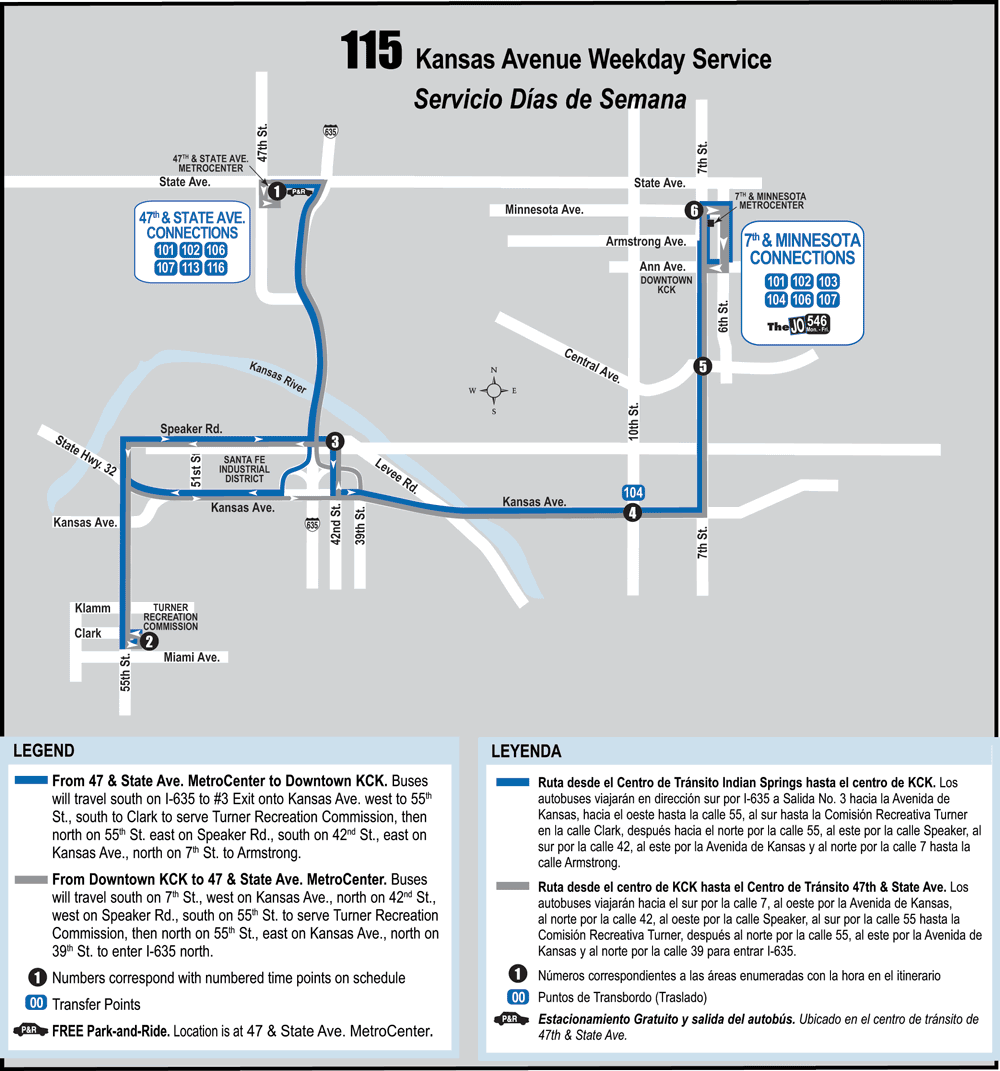
The Unified Government pays KCATA about $3.5 million annually to operate 4-1/2 "fixed route" bus lines in Wyandotte County. In return for our payment, KCATA provides all the equipment and personnel to run the routes. Why is it 4-1/2 routes instead of 5? Here's the breakdown...

#101 - State Avenue Connex

(click to enlarge)
#104 - Argentine

(click to enlarge)
#106 - Quindaro

(click to enlarge)


#107 - 7th Street

(click to enlarge)

KCATA operates these routes using their standard 30-foot "The Metro" bus.

This is the standard 30-foot ATA bus.

None of these routes have enough ridership to qualify as a KCATA "MAX" line (yet), but Emerick Cross (Director of Transit for the Unified Government) says that ridership on Route 101 (the State Avenue Connex line) is growing so fast that it may soon qualify to have the 45-foot Metro Area Express (MAX) bus.

Here's the 45-foot MAX bus.
None of these run in Wyandotte County yet.

KCATA and the Unified Government share responsibility for Route #102 (Central Avenue)... hence the "half" a route comment earlier. KCATA uses its 30-foot buses during peak hours (mainly morning and afternoon rush hours) and the Unified Government operates its shorter 22-foot buses the rest of the day.

(click to enlarge)

The UG owns 17 of these 22-foot buses.
They are mainly used on routes that KCATA does not cover.

Since the routes operated by KCATA don't really cover all parts of Wyandotte County, the Unified Government operates its fleet of 17 smaller buses on four additional "fixed route" lines on weekdays. We spend another $1.7 million to operate these routes and provide other specialized transportation services in the county.

#103 - 3rd St./Fairfax

(click to enlarge)
#113 - Leavenworth

(click to enlarge)
#115 - Kansas Ave

(click to enlarge)
#116 - West Parallel

(click to enlarge)

In conversation with Mr. Cross, he pointed out that there are many challenges to providing effective and efficient bus service in Midwest cities like Kansas City.

First, our Midwest cities tended to grow "out" rather than" up", which means that the routes stretch out for long distances. This increases wear and tear on the buses and adds to fuel consumption.

Additionally, ridership is typically very heavy during morning and afternoon rush hours, but may be very light in other parts of the day. This creates a very challenging staffing problem. If we don't provide enough drivers and equipment at rush hour, we frustrate (or strand) those people who are trying to ride the bus to and from work. However, if we keep all of those drivers and buses on the street during the non-peak hours, we run the risk wasting money as the buses may drive around empty.

Here are a few other things I learned today about bus transportation in Wyandotte County:

  • Ridership is up 21% county-wide over the past two years. The State Avenue Connex route, in particular, is exploding with riders.
  • The Unified Government recently switched all 17 of its smaller 22-foot buses to propane fuel instead of gasoline. So far, this move has yielded a 40% savings in the cost of fuel!
  • The Unified Government only gets about four cents back in rider fares for every one dollar it spends on operating the bus system.
  • The Unified Government is the only government / organization in the metro that provides specialized bus services like Senior Group Transportation and "Aging Transit" services for medical visits or grocery shopping.

Your can learn more about all the transportation services offered by the Unified Government on the UG Transit page of our web site.

Click one of the links below to send me a note if you have a question or comments about the bus system in Wyandotte County.

Have a great week!
~ Brian

bmckiernan@wycokck.org
- or -
Suggestion Box